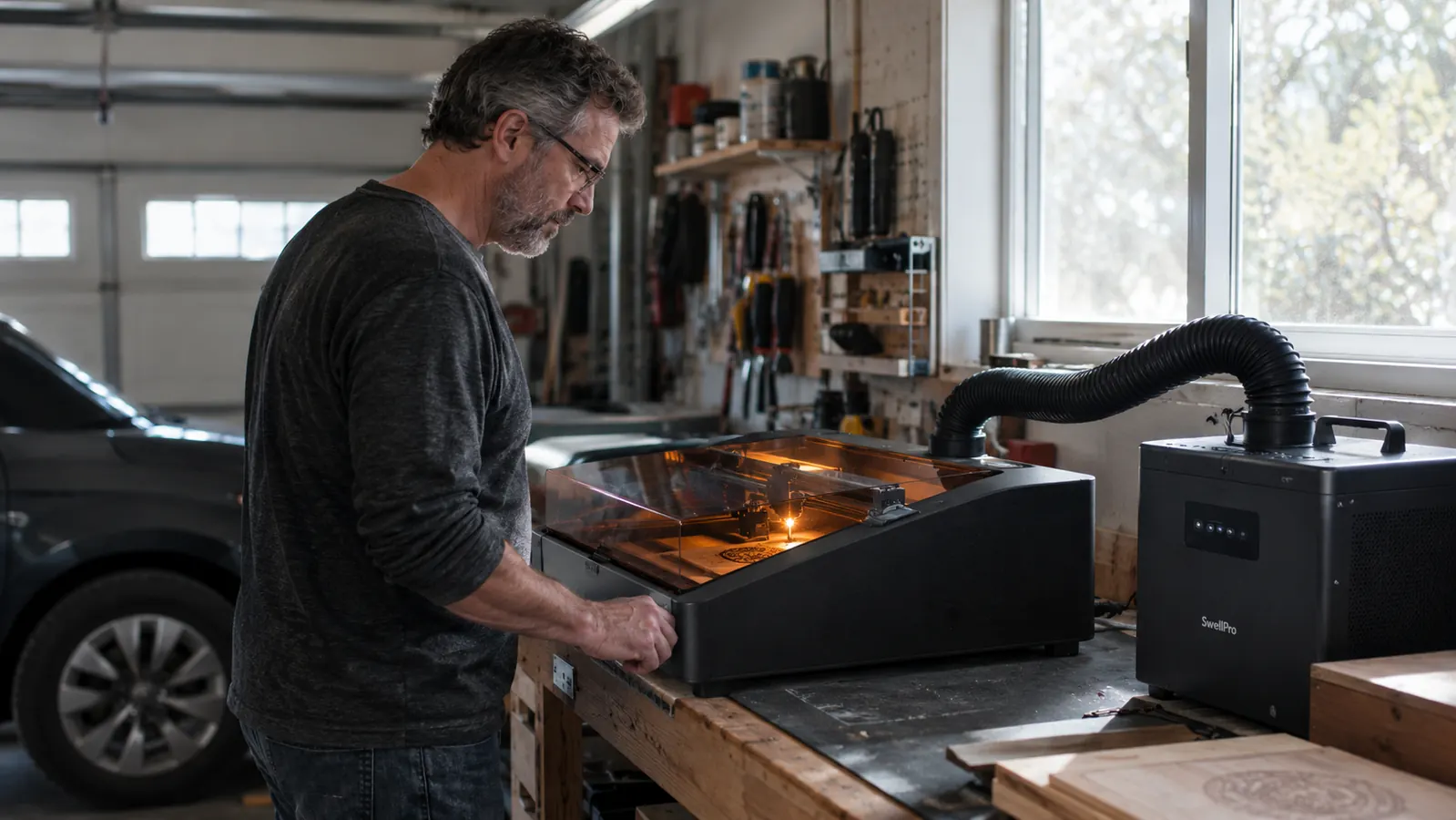
The first time I ran my laser engraver without a smoke purifier, I opened the garage door, turned on a box fan, and told myself that would be enough. Twenty minutes later my eyes were watering, my wife Linda could smell the garage from the kitchen, and the neighbor two houses down asked if something was burning. That was during my first year with a laser, long before I bought the xTool Desktop Smoke Purifier, and it is the reason I tell every beginner the same thing: the laser is half the setup, the air handling is the other half.
I have now run the xTool Desktop Smoke Purifier almost every day for six months in my two-car garage in Tucson. I engrave hardwood cutting boards, leather patches, slate coasters, and powder-coated tumblers for weekend craft fairs and my Etsy shop. This review covers what the purifier actually does in a real garage, how long the filters last, how loud it is, and where it falls short.
The Quick Verdict
The xTool Desktop Smoke Purifier clears the air in a small workshop far better than a box fan and an open door, and it is quiet enough to run while you work. It is not a replacement for a vented window setup on heavy production days, but for a one-machine garage shop it is the difference between a workspace you can breathe in and one you avoid.
Amazon Check Today's Price →Stop Breathing What You're Burning
If your garage smells like a campfire after every engraving session, the xTool Desktop Smoke Purifier is the fix. It pulls smoke and fumes at the source and filters them through a three-layer HEPA system before the air gets back to your lungs.
Amazon Check Today's Price on Amazon →How I've Used It
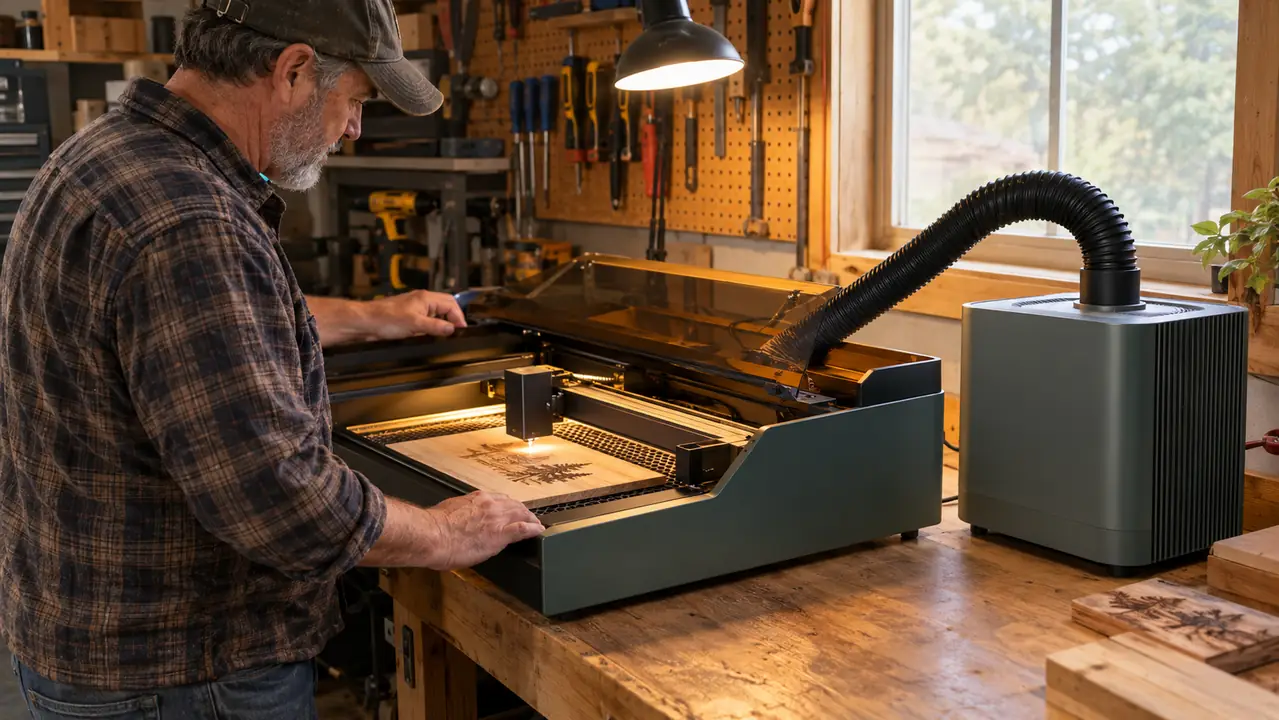
My setup is a two-car garage with a workbench along the back wall, a window I can open for extra airflow, and a shop vac in the corner. My engraver sits on the bench with the xTool Desktop Smoke Purifier next to it. The hose reaches the engraving bed without any strain, and the unit itself takes up about the same footprint as a small desktop printer.
I run it for every job, not just the smoky ones. A 20-minute cutting board engraving produces less smoke than a leather patch job, but it still produces enough that I notice the difference when the purifier is on. On a typical week I do maybe 12 to 15 jobs, and the purifier runs for two to three hours at a stretch. On craft fair prep weeks, when I am batch engraving 30 tumblers, it runs most of the afternoon.
Before every job I switch the purifier on first, give it a few seconds to get the air moving, and only then start the laser. When the job finishes I let it run for another five minutes before I open anything up. That habit came from watching the curl of smoke that escaped every time I lifted a lid too early, right at face height. Five extra minutes of fan noise is a fair trade for not breathing that.
The first thing I noticed was how quickly the air clears. With the box fan and open door, the garage took 20 minutes to air out after a job. With the purifier running during the job, the air is noticeably cleaner within a couple of minutes of the laser finishing. My eyes stopped watering, and Linda stopped asking from the kitchen whether something was on fire.
The second thing I noticed took a few weeks to show up: the garage stayed cleaner. Before the purifier, a fine tan film settled on everything near the bench, the shelves, the window sill, the top of the shop vac. I used to wipe the window glass every couple of weeks and the rag came away brown. Now I wipe it about once a month and the rag comes away grey, mostly from ordinary sawdust off the table saw. That film was smoke residue, and if it was landing on the window glass, it was landing in my lungs too. Seeing it stop is what convinced me the filters were doing real work and not just masking the smell.
What the Three-Layer Filtration Actually Does
The xTool Desktop Smoke Purifier uses a three-layer filtration system. The first layer catches the larger particles, the kind of visible smoke and ash that comes off burning wood. The second layer is a HEPA filter that handles the fine particulate, the stuff you cannot see but can feel in your throat. The third layer is an activated carbon filter that absorbs the odors and volatile organic compounds, which is what makes laser engraving smell like a burnt match factory.
I tested this the way a shop teacher would. I ran a piece of birch plywood with the purifier off for 30 seconds, then turned it on and kept the laser running. The visible smoke stopped drifting across the garage within about 15 seconds and started moving toward the intake instead. The smell did not disappear instantly, but it stopped spreading. That is the difference between a purifier and a fan: a fan moves the smoke around, the purifier pulls it in and traps it.
Leather is the real test. Engraving leather produces a sharp, acrid smell that a box fan just redistributes. With the xTool purifier running, the leather smell is still there if you put your nose right at the engraving bed, but it does not fill the garage. For a material that smells like burning hair without filtration, that is a meaningful result.
Acrylic is the other material worth mentioning. Cast acrylic gives off a sweet, chemical smell when it is cut, and it is the one that used to give me a headache by the end of a batch of keychains. With the purifier pulling at the bed, I can finish a sheet of keychains without that dull ache behind the eyes. I still keep the window cracked for acrylic, because I would rather be careful with plastics, and I never put anything on the bed unless I know what it is. PVC and vinyl stay out of the garage entirely, purifier or not.
Filter Life and Replacement Reality
The filter life question is the one everyone asks me at craft fairs, and it is the one the marketing materials do not answer clearly. xTool says the filters last a certain number of hours depending on what you engrave, and that estimate has matched my experience if you are honest about your material mix.
I keep a notebook on the workbench and log every job. In six months I have run the purifier for roughly 180 hours. Around the 150 hour mark I could feel the suction at the hose weakening and the leather smell creeping back, which roughly lines up with the manufacturer's estimate for mixed wood and leather use. I replaced the filter at about 160 hours because I was heading into a week of heavy leather work and did not want to risk the smell getting worse mid-batch.
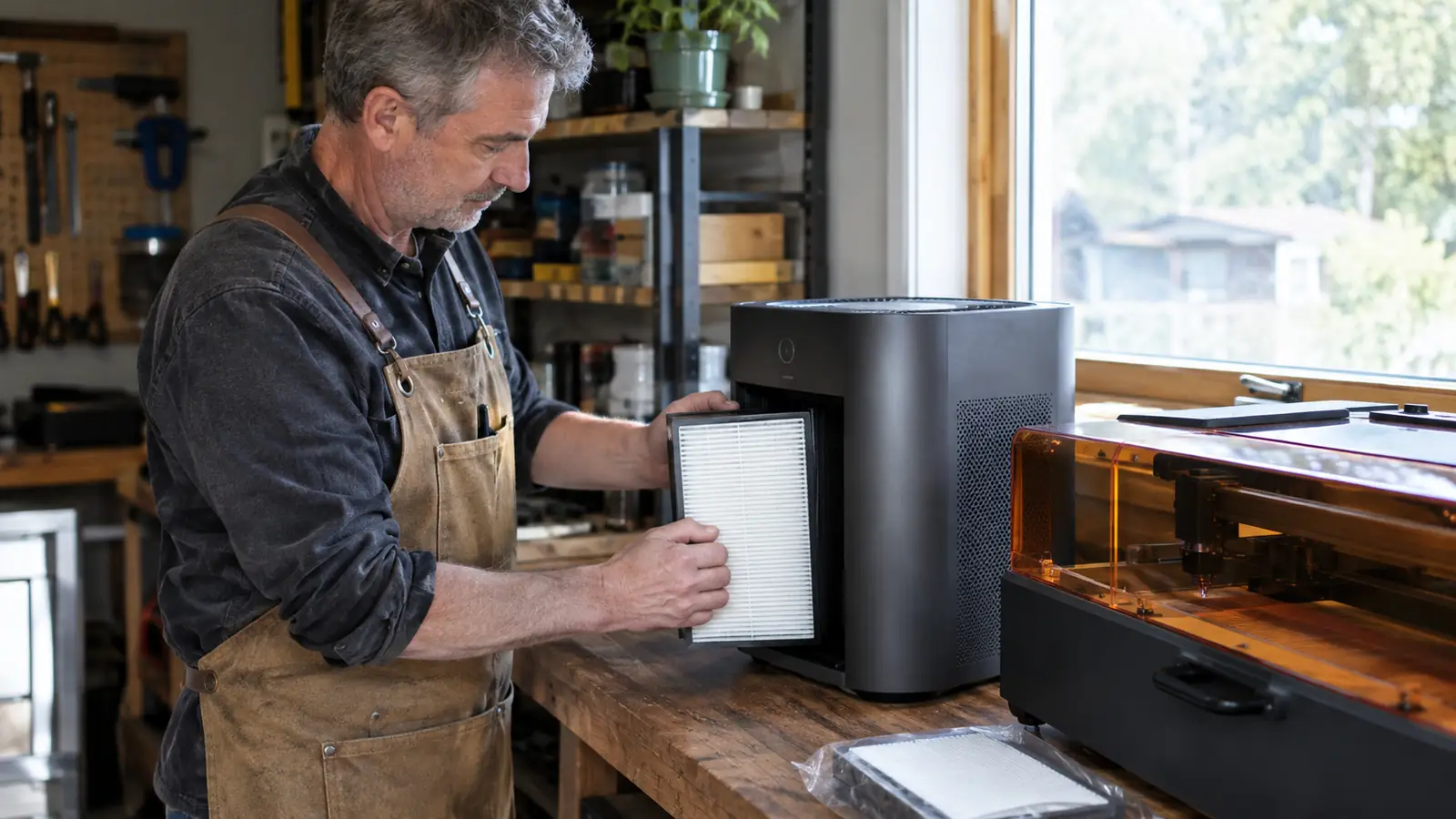
The replacement process is simple. The filter slides out of the front of the unit, the new one slides in, and I start a fresh page in the notebook. It took me about two minutes and I did not need any tools. The filters are not cheap, but they are cheaper than the alternative, which is breathing fine particulate every time you engrave.
Here is how I think about the filter cost, since it is the question that comes up most. I spread it across the jobs I sell. A cutting board or a tumbler only uses a small slice of a filter, and once I looked at it that way, the filter stopped feeling like an expense and started feeling like a consumable, the same as the blanks and the masking tape. I keep one spare filter on the shelf at all times now. Running out in the middle of a craft fair prep week, with thirty tumblers waiting and no way to get a replacement before Saturday, is not a position I want to be in twice.
Noise, Airflow, and the Garage Test
The xTool Desktop Smoke Purifier is quieter than I expected. On the low setting it is about as loud as a refrigerator hum, and on the high setting it is about as loud as a conversation. I can run it on high while the laser is cutting and still hear the laser's own sounds, which matters when you are watching for a burn-through or a warped board.
Airflow is where the unit earns its keep. The intake hose sits close to the engraving bed, and the suction is strong enough to pull smoke from the work area before it rises to face level. I measured the difference with a simple test: I stood at the workbench with the purifier off and then on, and the smoke that used to hit me in the face now gets pulled sideways toward the intake. That is the whole job, and it does it.
The one limitation is volume. This is a desktop purifier, not a whole-shop ventilation system. If I am running a long production batch of 30 tumblers, the purifier keeps the air breathable but the garage still gets warm and the smell lingers longer than it would with a window vent. On those days I open the window and run a fan as backup. For a single machine and a normal job, the purifier handles it alone.
Placement matters more than I expected. For the first month I had the purifier on the floor under the bench, which looked tidy and worked badly, because the hose had to climb and bend and the suction at the bed dropped off. Moving it up onto the bench beside the laser, with the hose running short and straight, made an obvious difference the same afternoon. Keep the hose as short and straight as your setup allows, and check that the connection at the machine is snug. A loose fitting leaks smoke right where you are standing.
What I Liked
- Pulls smoke at the source before it reaches your face
- Quiet enough to run on high while the laser is working
- Three-layer filtration handles both visible smoke and odors
- Filter replacement takes about two minutes with no tools
- Compact footprint fits on a standard workbench
- Makes leather engraving tolerable in a closed garage
Where It Falls Short
- Filters need replacing more often than the box suggests if you do a lot of leather
- Not a replacement for venting on heavy production days
- The hose reach is fine for a desktop machine but tight for a larger setup
- You have to track filter hours yourself to know when to change it
The difference between a purifier and a fan is simple: a fan moves the smoke around, the purifier pulls it in and traps it.
Who This Is For
The xTool Desktop Smoke Purifier is for the person who engraves in a garage, a shed, a spare room, or any space that does not have a dedicated ventilation system. If you are a beginner setting up your first laser, buy the purifier at the same time you buy the machine. I made the mistake of thinking I could save money with a box fan and an open door, and I spent three years with watery eyes before I fixed it.
It is also for the person who does a mix of materials. Wood smoke is visible and annoying, but leather and acrylic produce fumes that are harder to ignore. The three-layer filtration handles both, and the activated carbon layer is what makes the difference on the smelly jobs. If you only ever engrave slate coasters, you might get away with less. If you engrave anything organic, get the purifier.
Check compatibility before you order. The Amazon listing names the xTool M2, F2, F1 and M1 Ultra, and those are the machines it is built to connect to without fuss. If you run a different machine, read the listing and the questions section carefully and plan on an adapter for the hose, because a purifier that does not seal to your machine's exhaust port pulls in garage air instead of smoke.
Who Should Skip It
If you already have a window vent or an external exhaust system that pulls fumes out of your shop, the xTool Desktop Smoke Purifier is a convenience, not a necessity. It will still help on days when you do not want to open the window, but you are paying for filtration you already have.
If you run a commercial shop with multiple lasers running all day, this is not the tool for you. It is a desktop unit designed for one machine in a small space. For a production shop, you want a larger extraction system with ducting. And if you are the kind of person who will never replace a filter on schedule, be honest with yourself. A purifier with a clogged filter is just an expensive fan.
The Air in Your Garage Is Worth Fixing
Six months in, the xTool Desktop Smoke Purifier is still the piece of equipment I would not give up. If you are tired of breathing your own work, this is the fix that actually works in a real garage.
Amazon Check Today's Price on Amazon →