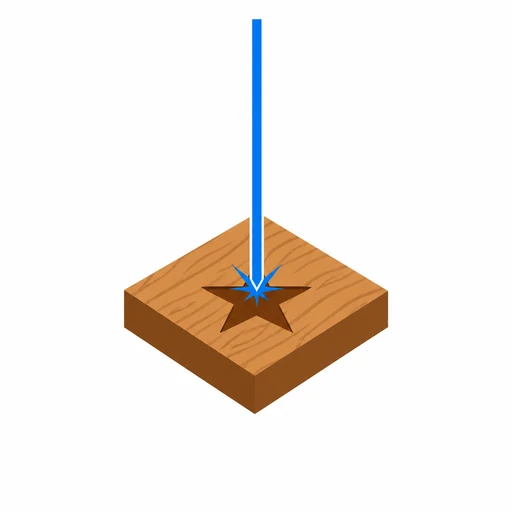
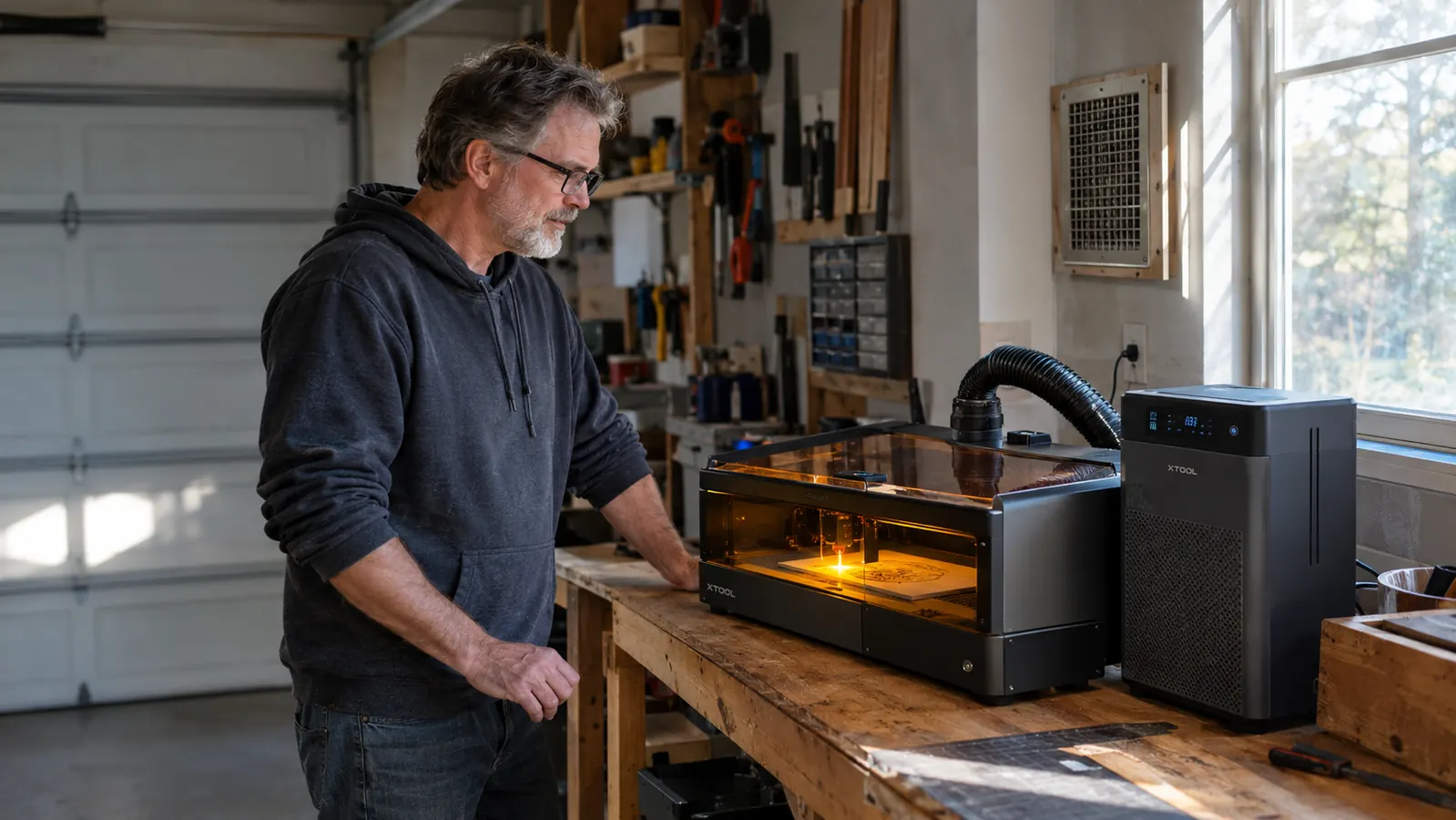
I'll be honest with you: my first year of laser engraving in our garage smelled. Not a little. My wife Linda could tell from the kitchen the moment I ran a job with the door closed, and the smoke stain above the workbench took two coats of primer to cover. If you are reading this because you just fired up a new engraver and the garage smells like a campfire, you are in the right place. This is the plan I worked out over four years and a lot of burned boards, and it starts with one piece of gear I wish I had bought on day one: the xTool Desktop Smoke Purifier.
The problem is not just the smell, although the smell is the part that sends people to the internet at midnight. Engraving smoke is vaporized wood resin, burned adhesive, and in the case of leather, some compounds you do not want to breathe all afternoon. In an enclosed two-car garage it hangs around for days. It settles on the walls, finds its way into the tumblers you are about to sell, and if you run long jobs it makes your eyes water by the third hour. The fix is not one thing. It is a system: capture the smoke at the source, filter it, move the air out, and pick materials that make less smoke in the first place.
Cut the smoke before it reaches the rest of the garage
The xTool Desktop Smoke Purifier sits next to the engraver, pulls the fumes through a three-layer filter, and sends clean air back into the room. It is the single biggest difference between a garage that smells like a workshop and one that smells like a garage.
Amazon Check Today's Price on Amazon →Step 1: Put the purifier beside the engraver, not across the room
The biggest mistake I see in the laser Facebook groups is placement. People set the purifier on a shelf across the garage because it looks tidy, then wonder why the smoke drifts everywhere before it gets pulled in. Smoke rises and spreads the way water spreads, and it does not care about your shelf. The purifier needs to be close enough to catch the plume before it does. I keep mine on the workbench, about 14 inches to the right of my engraver, with the intake facing the machine. It is not a decoration; it is a vacuum cleaner for smoke, and a vacuum cleaner works best when the nozzle is near the dirt.
Why it matters: the xTool purifier pulls air through a three-layer filter at a rate that handles a desktop engraver, but it is not a whole-garage air scrubber. It is a source-capture tool. Within about a foot of the engraving bed, it catches the plume while it is still moving upward and before it mixes with the rest of the air. From across the room, it just recirculates whatever smoke has already spread. Same machine, same filters, completely different result. The spec sheet does not tell you this, but placement is 80 percent of the battle.
I learned this the slow way. The first purifier I borrowed from a friend sat on the floor under the workbench, which is the worst possible spot because smoke rises. I ran a batch of cutting boards and came back to a garage that looked like a barbecue. The next weekend I moved the unit onto the bench at bed height, and the difference was immediate. Same boards, same settings, and the smoke went from filling the room to curling straight into the intake. My wife noticed from the kitchen before I said a word. That is how I knew it was not my imagination.
Step 2: Match the fan speed to the material you are cutting
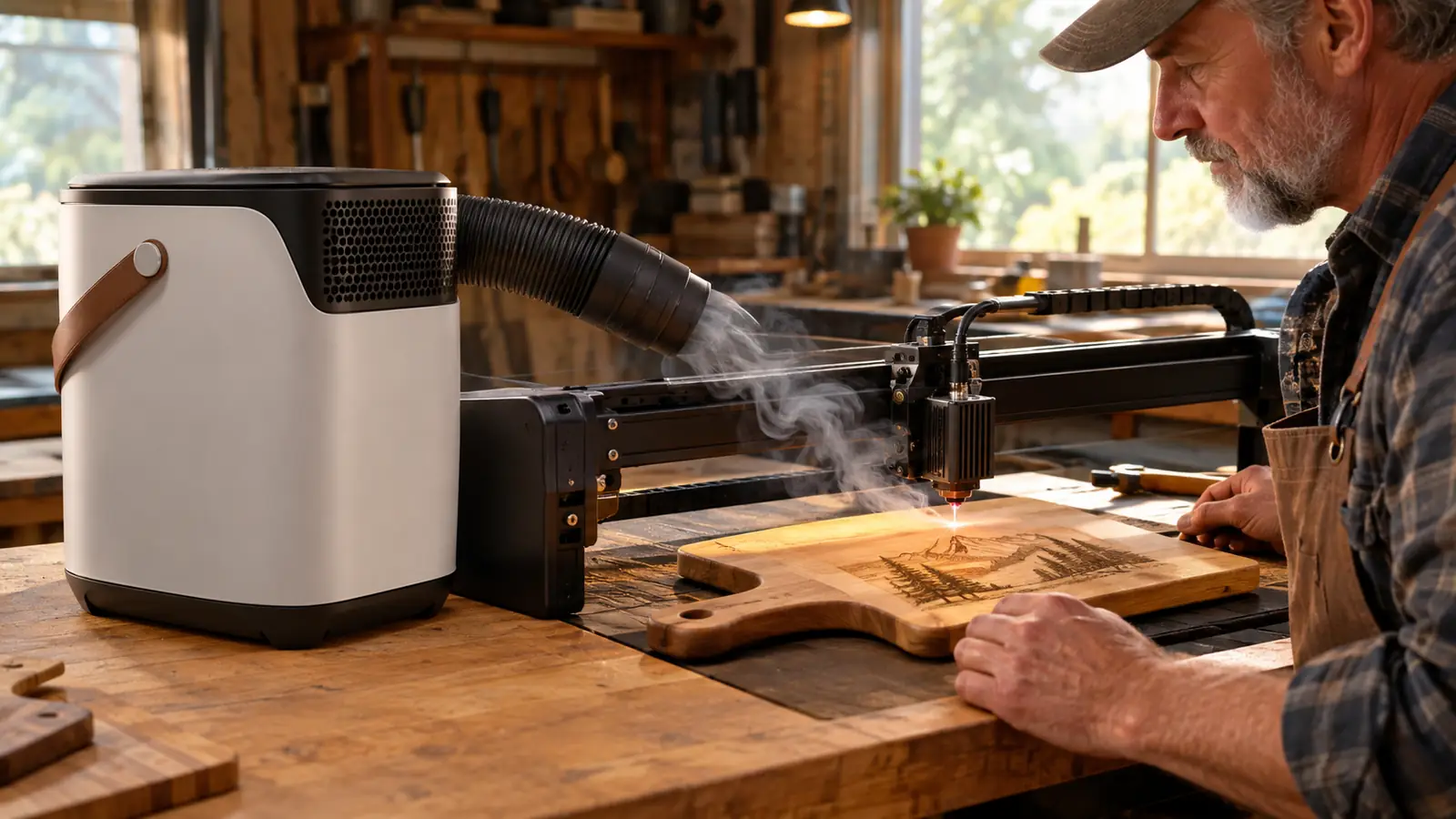
The xTool purifier has speed settings for a reason, and I think most people leave it on one setting forever. On low it is nearly silent, which is fine for slate coasters and light engraving on hardwood. On high it pulls noticeably harder, which you want for leather, rubber, and anything with a coating. My rule after a lot of trial and error: if you can smell the job from three feet away, the fan is not fast enough. If you can see the smoke, you are two settings behind.
One Tuesday night last February I ran 60 leather patches for a craft fair order and left the purifier on medium, the same setting I use for cutting boards. By the tenth patch I could smell it. By the thirtieth my eyes were watering. I switched to high and opened the window, but the damage was done; the garage smelled for three days, and I had to run the purifier on low for a full evening just to pull the lingering odor out of the air. Leather engraving produces a dense, oily smoke that needs maximum suction and, ideally, an exhaust duct behind it.
The reverse is also true. Running the purifier on high for a job that barely smokes just fills the garage with filter noise and wears the filters out faster, and replacement filters are not free. Slate coasters, for example, make fine dust more than smoke, and I run those on low and sweep up afterward. Powder-coated tumblers smell like warm metal more than smoke, and medium handles them fine. The trick is to treat the fan speed as part of the job setup, the same way you set the power and speed of the laser, not something you set once and forget.
Step 3: Duct the exhaust out the window for heavy jobs
Here is the honest part nobody puts on the box: a filter purifier cleans the air, but it does not make the smoke disappear. The charcoal layer traps a lot of the odor and the HEPA layer catches particles, and for most jobs that is plenty. But for a long batch of leather, or a sheet of plywood with a lot of glue in it, the smell will still build up in a closed garage. That is when I use the window. This is the difference between a garage that smells fine and a garage that smells like a workshop you want to leave.
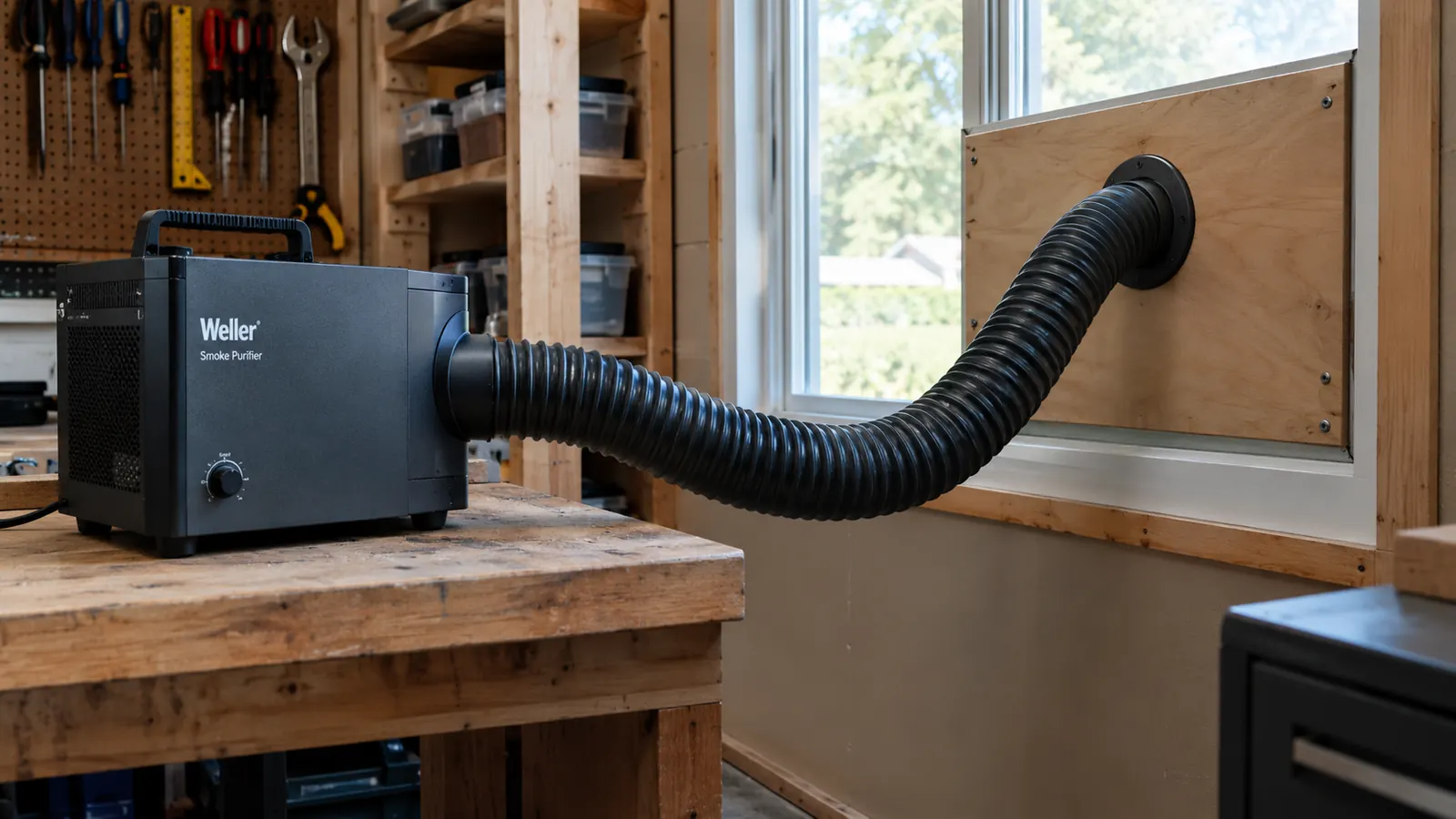
My garage has a window on the side wall, about six feet from the workbench. I built a simple plywood panel that fits in the window frame with a six-inch hole cut in it, and I run a flexible duct from the purifier's exhaust port to the panel. It is not fancy, and it did not cost much, but it turns the purifier into a proper fume extractor. On heavy job nights, I run the purifier on high with the duct hooked up, and the garage smells like nothing an hour later. If you are handy with a jigsaw, you can build this panel in an afternoon.
The duct setup is the thing I wish I had built in year one. Before that, I tried the obvious shortcut: opening the garage door and pointing a box fan at the window. That worked okay in October and failed completely in July, because in Tucson you close the door after ten minutes or you melt. The box fan also stirred the smoke around the room before it found the window, which meant the whole garage smelled instead of just the corner near the machine. A ducted exhaust is not more complicated; it is just more direct, and direct wins every time.
Step 4: Change the filters on a schedule, not on a smell
The xTool purifier has a filter indicator, and I ignored it for exactly as long as it took to ruin a weekend. Last March I was running a big order of powder-coated tumblers, the kind of job where you set up, start, and check your phone for an hour. The filter had been in use for months. The indicator had been blinking for a week. I told myself it could wait until the order was done, because stopping a running job to swap a filter costs an hour of setup time.
It could not wait. By the second batch of tumblers the garage smelled like a soldering iron, and the smoke was visibly drifting past the purifier instead of going into it. A clogged filter stops pulling air, and a purifier that stops pulling air is just an expensive box on your bench. I finished the order with the window duct hooked up and the fan on high, then ordered a replacement filter set and put a reminder on my phone for the first of every month. The reminder has saved me twice since.
Now the schedule is simple. I check the filter before the first job of every month. I replace it when the indicator lights up, or after a heavy leather run, whichever comes first. A set of replacement filters costs less than re-priming the garage walls, and a fresh filter pulls noticeably harder; you can hear the difference in the fan note. Think of it like the oil in a car. The machine runs fine right up until the moment it does not, and the smoke will tell you exactly when you were too cheap to change it.
Step 5: Choose materials that smoke less and skip the worst
The best smoke control is not making the smoke in the first place. After four years I have a short list of materials I cut regularly, and the list tells you a lot about which ones smoke. Hard maple and walnut cutting boards engrave clean and produce a light, pleasant woodsmoke smell that the purifier handles easily. Slate coasters make dust, not smoke, so they are easy on the filter. Powder-coated tumblers smoke a little, but they smell like nothing, and the purifier on medium handles them fine.
The materials I avoid are the ones that taught me lessons. Rubber stamps smoke like a tire fire; I learned that on a Tuesday night in February, and the garage smelled for a week despite the purifier running on high. Plywood with a lot of glue in the core is not far behind, because you are burning glue as much as wood. Anything with a plastic coating, and I mean anything, produces the kind of smoke that makes you close the garage door and walk inside for an hour. MDF is in the same category; it smells like a chemistry set.
I am not saying never use those materials. I am saying know what you are signing up for before you start. When I do a one-off rubber stamp for a customer, I run the purifier on high, hook up the window duct, and keep the job short. When I engrave leather for a batch order, I do the same. The purifier plus the duct handles it, and the garage is fine by morning. But for everyday production, I steer toward the materials that keep the garage pleasant, because I still have to walk into that garage the next day to set up the next job.
What Else Helps
A purifier is the center of the system, but it is not the whole system. I also keep a shop vac with a fine dust bag next to the bench for slate and wood dust, and I sweep before I run the purifier, because dust on the floor gets stirred up and adds to the haze. I crack the window an inch even on clean jobs, just to keep fresh air moving, and I run the purifier for twenty minutes after the last job to clear the residual smell. That last step is the one most people skip, and it is the difference between a garage that smells fine in the morning and one that smells like yesterday.
Fire safety belongs in any conversation about smoke. I keep a fire extinguisher by the garage door, not by the machine, so I can grab it on the way out. I do not run the engraver unattended, even with the purifier on, because a job that jams can burn a board in seconds. And I keep the area around the machine clear of sawdust and cardboard, which is exactly the kind of fuel a stray beam will find. None of this is complicated. It is just the habit of a shop teacher who has seen what happens when people skip the boring parts.
I moved the purifier from the floor to the bench, 14 inches from the machine, and the smoke stopped filling the room and started going into the intake. Placement is 80 percent of the battle.
Start with the purifier, then build the system around it
The xTool Desktop Smoke Purifier is the piece I would buy first if I were starting over. Put it beside the machine, run it on high for leather, duct it out the window for heavy jobs, and change the filters on a calendar schedule. The garage will smell like a garage again, and your wife will stop asking what burned.
Amazon Check Today's Price on Amazon →