I bought the xTool Desktop Smoke Purifier eight months ago because my garage smelled like a barbecue pit every time I engraved a cutting board. My wife Linda stopped coming out to the workshop, and I could not blame her. The machine does pull the smoke out of the air and it does cut the smell down to almost nothing. But there are things about it that the product page does not tell you, and a few of them cost real money. This is the honest version, the one I wish someone had walked me through before I ordered.
The Quick Verdict
The xTool Desktop Smoke Purifier is a well-built, genuinely effective filter for a small workshop, but the replacement filters are expensive and the fan is louder than the marketing suggests. Buy it if you engrave indoors and cannot vent out a window. Skip it if you are on a tight budget or you only cut wood a few times a month.
Amazon Check Today's Price →Stop breathing what you are burning
The xTool Desktop Smoke Purifier pulls laser smoke and odor through a three-layer filter so you can engrave indoors without filling the room. See today's price and current filter options on Amazon.
Amazon Check Today's Price on Amazon →How I've Used It
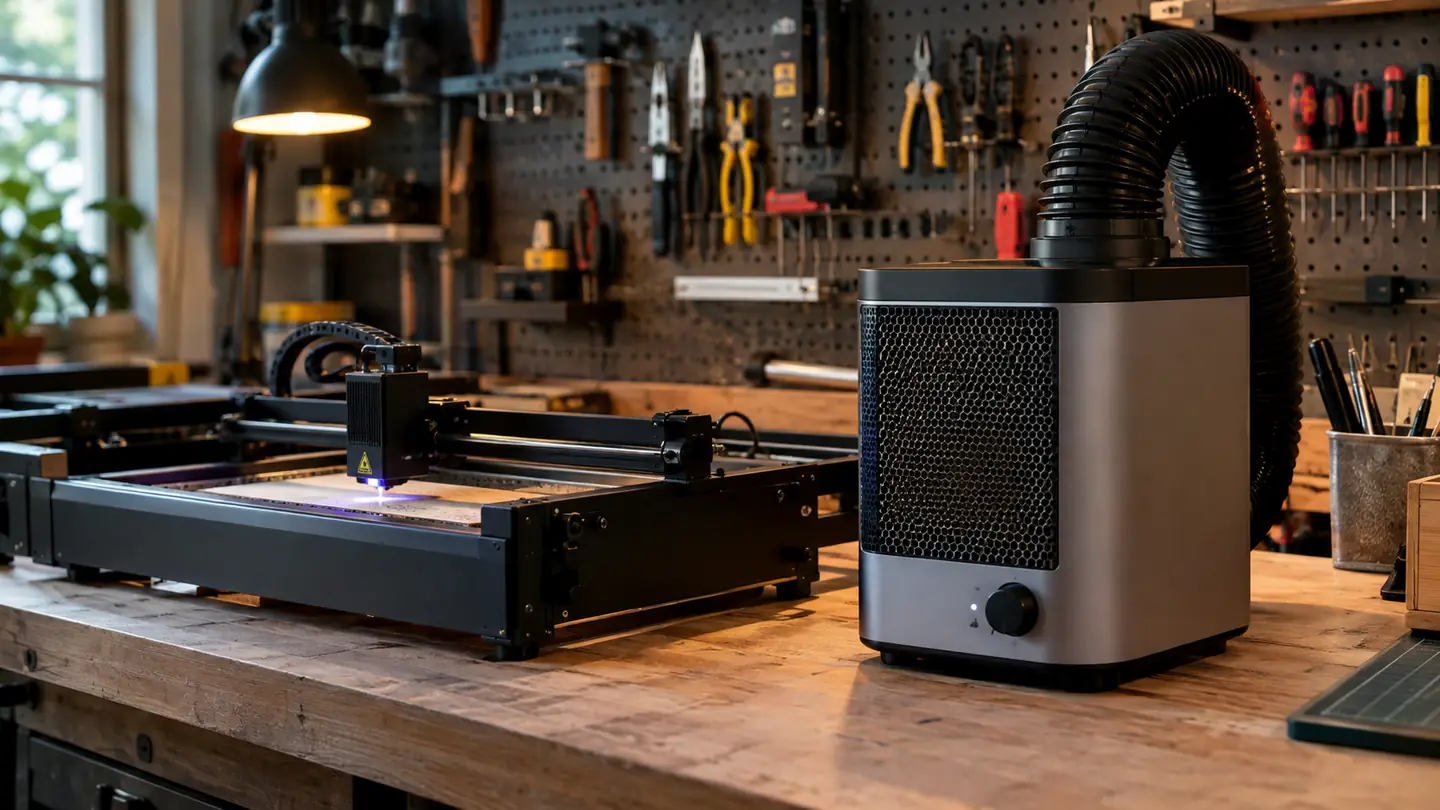
My setup is a two-car garage with a workbench along the back wall, a window I used to vent through, and a shop vac. I run an xTool M1 Ultra, which is the machine this purifier is designed to sit next to. The purifier connects to the laser with a hose, pulls the smoke through its filters, and blows clean air back into the room. I have used it for hardwood cutting boards, leather patches, slate coasters, and powder-coated tumblers. That last one, the tumblers, is where the machine earns its keep, because powder coating puts out a smell that a window fan alone will not touch.
I ran it for eight months before writing this, which means I have been through the filter replacement cycle twice. I kept a log of how long each filter lasted, how loud the fan got, and what the air smelled like after a long session. I also tested it the way a skeptical shop teacher would: I ran it without the filters seated properly, I ran it with the hose kinked, and I ran it with the window closed to see how bad the room would get. The machine handled all of it, but the details matter, and those details are what this review is about.

What the Three-Layer Filtration Actually Does
The xTool Desktop Smoke Purifier uses a three-layer filter system. The first layer catches the big particles, the kind of visible smoke and ash that comes off burning wood. The second layer is a HEPA filter that catches the fine particles you cannot see. The third layer is activated carbon, and that is the one that does the real work on smell. If you have ever used a kitchen range hood or a shop air filter, you already understand the basic idea. The difference is that this unit is sized for a laser engraver, so it pulls a much higher volume of air through a much smaller footprint.
Here is what I learned by paying attention: the carbon layer is what makes the room smell clean, and it is also the part that wears out first. After about three months of steady weekend use, the smoke was still being pulled into the machine, but the room started to smell faintly of burnt wood again. That was my signal that the carbon was saturated. The HEPA layer still looked fine, but the carbon was done. That is the part of the running cost that nobody puts in the marketing photos.
I want to give you a concrete example from my log. On a Saturday in late February, I cut twelve maple cutting boards with a deep engraving on each one, roughly forty minutes of burn time per board. The purifier ran on high the whole afternoon. By the end of the day the visible smoke was gone and the garage smelled fine. Two weeks later I did the same job with the same settings, and the room had a sour, burnt smell by board nine. Same wood, same power, same hose. The only difference was the filter. That is how fast the carbon can go when you are doing production work, and it is the reason I now keep a spare set on the shelf.
The carbon filter is what makes the room smell clean, and it is also the part that wears out first. After three months of steady weekend use, I could smell burnt wood again.
Noise: Louder Than the Videos Suggest
The product videos show the purifier running quietly in the background while a laser engraves a design. That is not the full picture. On the low setting, the fan is noticeable but tolerable, about the level of a box fan on medium. On the high setting, which you will want for cutting wood or anything that produces heavy smoke, it is loud enough that I wear ear protection when I am in the garage for more than a few minutes. It is not deafening, but it is not background noise either. If you planned to run this in a living room or a bedroom, think again.
The noise also changes as the filters load up. A fresh filter lets the fan move air easily. A filter that is three months old makes the fan work harder, and you can hear the difference. That is actually a useful feature, because it gives you an audible warning that the filter is getting clogged. But it also means the machine gets louder over time, and the loudest point is exactly when you are most likely to be running a long job.
I measured the difference one Sunday afternoon because the sound bothered me enough to want numbers. With a fresh filter on the low setting, the fan sat at about the level of a conversation, and I could carry on talking to Linda at the door of the garage without raising my voice. On high, with a filter that was six weeks old, I had to step closer and speak up. It is not a scientific measurement, just my ear and my memory, but the jump was obvious. If you wear hearing protection for your table saw, you will want it for this too on long cuts.
Filter Replacement Cost: The Part Nobody Wants to Talk About
The filters are the real cost of owning this machine. The purifier itself is reasonably priced for what it does, but the replacement filters are not cheap, and you will need them more often than you expect. In my eight months of use, I replaced the filter set twice. That is roughly every three to four months with weekend use. If you engrave every day, you will replace them more often. If you only engrave a few times a month, they will last longer, but they will still need replacing because the carbon saturates with time even when the machine is not running.
I want to be direct about this because it is the single biggest objection I hear from other engravers. The filter cost is not a one-time expense. It is a recurring cost that you need to build into your pricing if you are selling your work. I started treating filter replacement as a cost of materials, like sandpaper or finish, and that changed how I thought about the machine entirely. It is not a purchase, it is a subscription to clean air, and you should go into it with your eyes open.
Here is the math I did at my kitchen table in March, after the second filter change. I divided what I spent on the replacement set by the number of boards, patches, and tumblers I had run through the machine since the first change. Spread across the work, the filter cost came out to a little under what I pay for a good sheet of sandpaper per job. That is the number that made peace with it for me. It is not free, and I am not going to pretend it is, but it is a predictable cost, and predictable costs are the ones you can price for.
Know the real cost before you buy
The xTool Desktop Smoke Purifier keeps your workshop air clean, but the filters are a recurring expense. Check today's price on Amazon and see the current filter bundle options while you are there.
Amazon Check Today's Price on Amazon →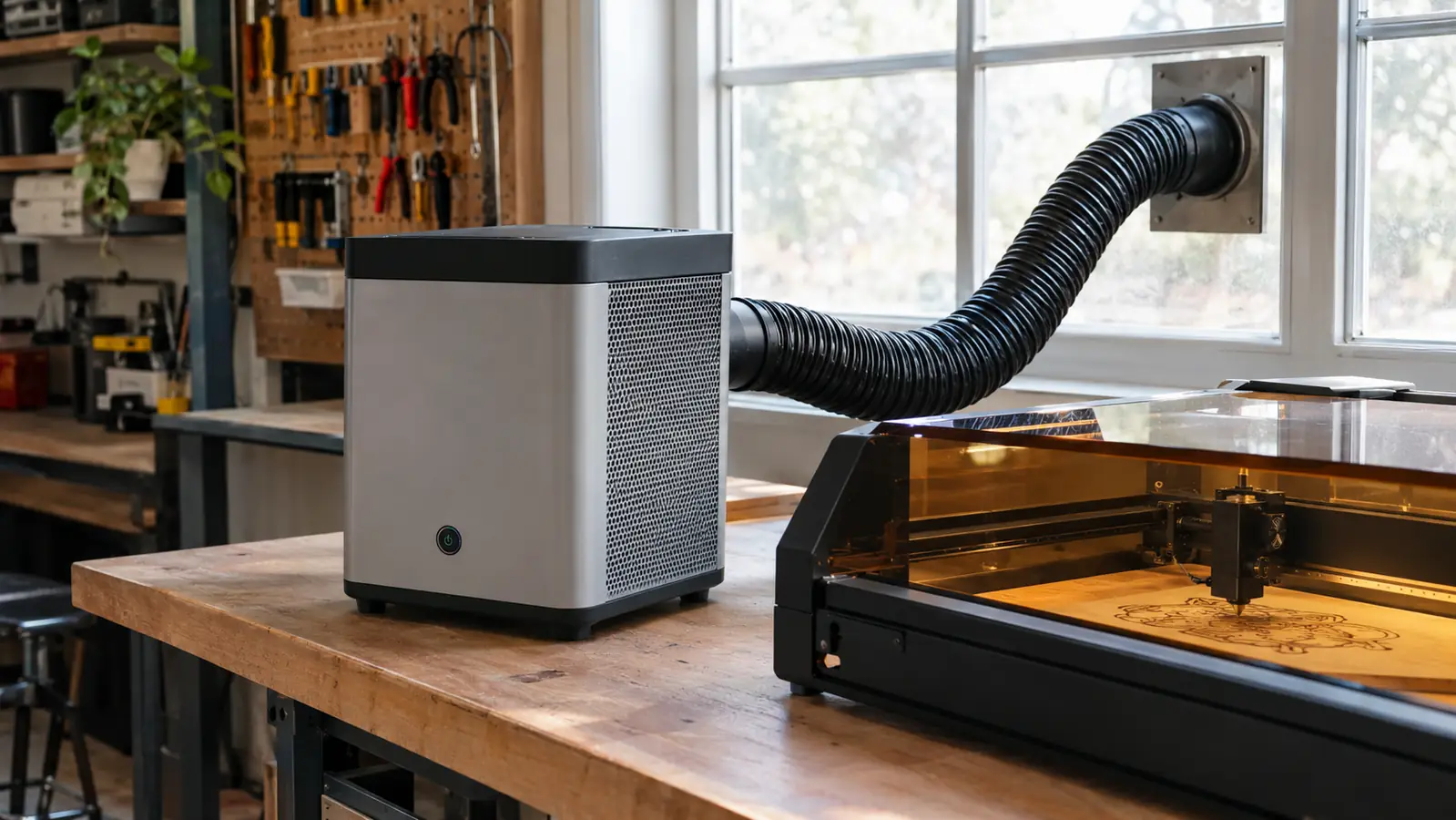
Which xTool Lasers It Fits
The xTool Desktop Smoke Purifier is designed for the M2, F2, F1, and M1 Ultra. I have only used it with the M1 Ultra, so I cannot speak from personal experience about the others, but the hose connection is the same across the line. If you have one of those machines, the purifier will connect directly. If you have a different laser, check the hose diameter before you buy, because adapters are not included and a loose connection will let smoke escape.
One thing I will say about the fit: the hose is not infinitely flexible. You need to position the purifier close to the laser, which means it takes up bench space. On my workbench, the purifier sits to the right of the M1 Ultra, and the hose makes a gentle curve between them. It works, but it is not a tidy corner setup. Measure your bench before you order, because this machine is bigger than it looks in the photos.
I learned that the hard way. When the box arrived, I cleared a spot on the left side of the bench, next to the shop vac, and the hose would not reach without a sharp bend that choked the airflow. I had to move the laser over six inches and swap the purifier to the right side before the hose sat in a smooth arc. That is ten minutes of rearranging that would have been zero if I had measured first. The manual lists the dimensions, but I did not believe them until the machine was sitting in front of me.
Where It Falls Short
I have three honest complaints. The first is the filter cost, which I already covered. The second is the noise, which I covered too. The third is the lack of a clear filter-life indicator. The machine has a light that tells you when the filter is due, but it is easy to miss, and I found myself relying on the smell test instead. A machine at this price point should give you a more obvious warning, especially when the replacement filters cost what they do.
I also want to mention that the purifier does not remove all odor. It removes most of it, and it removes the visible smoke almost completely, but if you are cutting something with a strong smell, like certain plastics or coated materials, you will still catch a whiff. That is not a failure of the machine, it is a limitation of carbon filtration. But it is worth knowing before you buy, because some reviews make it sound like the machine makes the room smell like nothing at all.
The filter light is the one that frustrates me most. On my unit, the indicator came on for the first time about a week after I had already noticed the smell, so it was telling me what I knew. The second time, I caught it early only because I happened to glance at the machine while I was reaching for a clamp. There is no audible alert and no way to see the remaining life as a percentage. For a machine that is otherwise well thought out, that feels like an oversight.
Who This Is For
This purifier is for the engraver who works indoors and cannot vent out a window. If you are in a garage, a basement, or a spare room, and you want to run your laser without filling the space with smoke, this machine does the job. It is also for the engraver who sells their work, because the difference between a workshop that smells like a workshop and a workshop that smells like a clean room shows up in how you feel at the end of a long day. I am not going to tell you it pays for itself in sales, because I cannot promise that. I will tell you that it made my garage a place I actually want to work in.
It is also for the person who has already tried the cheap route and gotten frustrated. I started with a box fan and a furnace filter taped to the back of it, and it worked about as well as you are imagining. Then I tried venting out the window with a dryer hose, which worked until the wind blew the wrong way and the smoke came back into the garage. The xTool purifier is the first setup that let me close the window in January and still run a job without fogging up the glass.
Who Should Skip It
Skip it if you only engrave a few times a month and you already have a window you can vent through. A simple vent hose setup will do most of what this machine does for a fraction of the cost, and you will not have to buy filters. Skip it if you are on a tight budget, because the filter replacement cost will surprise you. And skip it if you need silence, because this is not a quiet machine. It is a tradeoff, and the tradeoff is worth it for me, but it is not worth it for everyone.
I would also say this: if you are just starting out and you are not sure laser engraving is going to stick, hold off on the purifier until you have run the machine for a month. The smoke is unpleasant, but it will not ruin your equipment in that time, and you will know soon enough whether you are going to be a weekend engraver or someone who is in the garage every night. Buy the purifier when the work is regular, not when the idea is new.
What I Liked
- Genuinely removes visible smoke and most odor from a small workshop
- Three-layer filtration with a real HEPA layer, not just a carbon pad
- Connects directly to the M1 Ultra, M2, F2, and F1 with no adapter needed
- Runs for months between filter changes with weekend use
- Lets you work with the window closed in winter
Where It Falls Short
- Replacement filters are a recurring cost that adds up faster than the marketing suggests
- High fan setting is loud enough to need ear protection on long jobs
- Filter-life light is easy to miss and gives no percentage or audible alert
- Hose is not very flexible, so the purifier needs to sit close to the laser
- Does not remove every odor, especially from plastics and coated materials
Clean air is a cost of doing business
If you engrave indoors, the xTool Desktop Smoke Purifier is the difference between a workshop you use and a workshop you avoid. Check today's price on Amazon.
Amazon Check Today's Price on Amazon →